Almuñécar
Three thousand years by the sea
The Costa Tropical's biggest and busiest town — a Phoenician-rooted resort where castle, palms and pebble beaches meet the widest services on the Granada coast.
The feel of the place
Arrive in Almuñécar on a summer evening and the town is doing what it has done for three thousand years: living off the sea and enjoying itself while it does. Families promenade under the palms, the smell of grilling sardines drifts off the beach bars, and above it all the Castillo de San Miguel catches the last of the light. This is the largest resort town on the Costa Tropical and its unofficial capital — the most shops, restaurants, English spoken and general life. Not a quiet fishing village playing at being one, but a proper working town on a beautiful stretch of coast: heaving in August, still genuinely alive in January when smaller resorts have half shut down.
History — Phoenicians to the castle
Almuñécar's past is unusually deep, even by Andalusian standards. The Phoenicians founded it as Sexi, drawn by the fishing and sheltered anchorage, and the Romans built it into a town of real consequence. You do not need a museum ticket to see the evidence: stretches of Roman aqueduct still stand on the edge of town, Roman columbaria (tombs) survive on the hillsides, and the ruins of a Roman fish-salting factory — where the prized sauce garum was made — sit right in the seafront park. Crowning it all is the Castillo de San Miguel, Phoenician and Roman in origin, remodelled by the Moors and later rulers. The climb is steep but short, and the views from the walls — rooftops, twin bays, the sierra behind — explain why everyone who ever held this coast wanted this hill.
The old town
Below the castle, the old town is a tangle of whitewashed lanes climbing the hillside — narrow enough that you walk single file when a moped passes, punctuated by small plazas, potted geraniums and sudden glimpses of blue water. It is lived-in rather than prettified: washing on lines, neighbours talking across doorways, bars that have never seen a laminated menu. On a hot afternoon it is the coolest part of town, and getting mildly lost in it is a genuine pleasure.
The beaches and the paseo
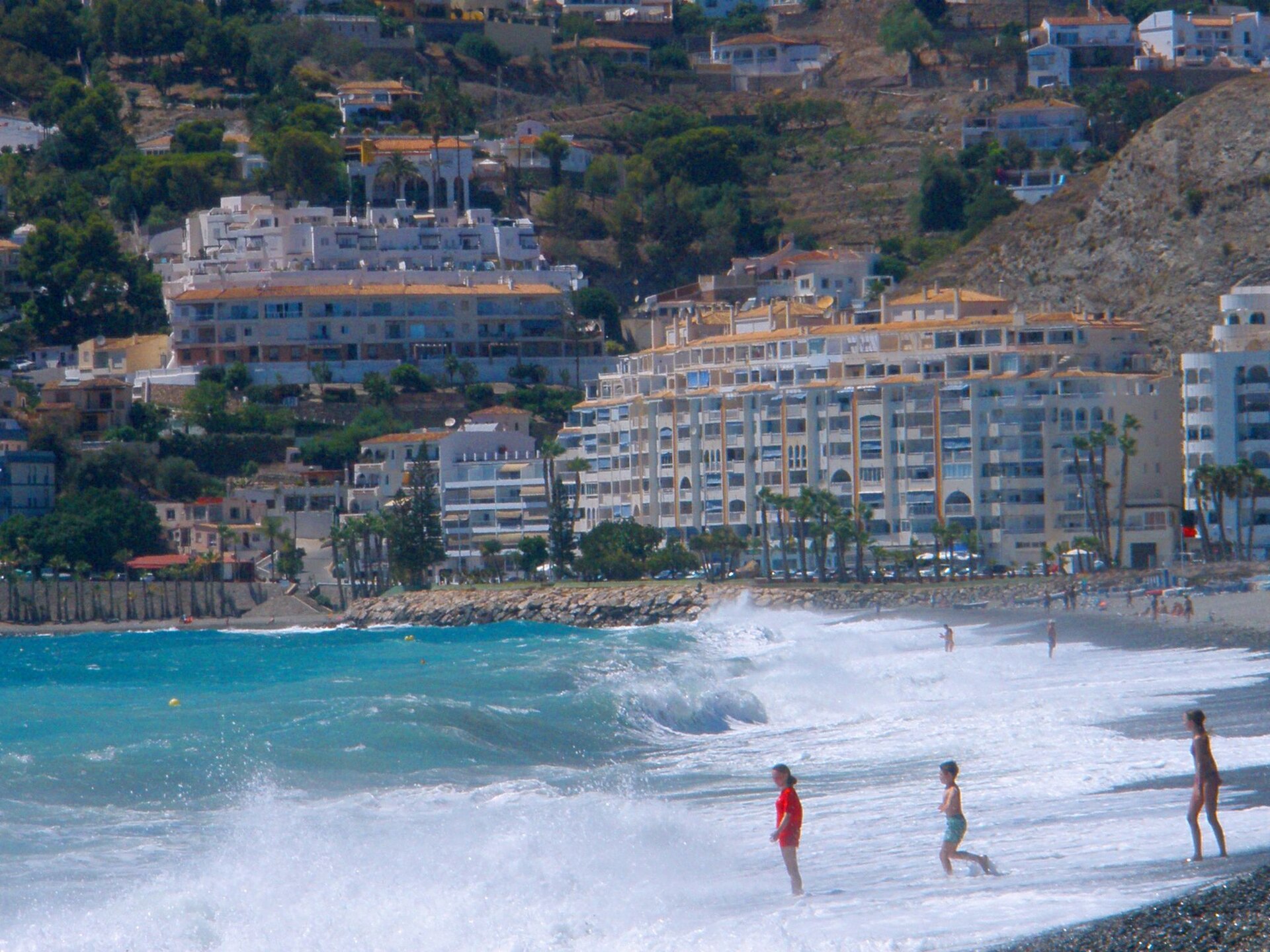
The shoreline splits around the Peñones del Santo, the rocky outcrop topped with a cross at the centre of town. West of it lies Playa de San Cristóbal, generally reckoned the best in town; east of it, Playa Puerta del Mar runs along the centre, and beyond that the long Playa de Velilla stretches towards the eastern suburbs. Be clear-eyed: this is the Granada coast, so the beaches are dark sand and pebble, not Caribbean white — bring beach shoes and you will be perfectly happy. The palm-lined paseo behind them is the town's social spine, busy with walkers, cyclists and café tables from breakfast until well after midnight in summer.
Things to do
At the foot of the castle, the Parque El Majuelo is a lush subtropical botanical park threaded around the Roman salting ruins — towering palms, exotic species, deep shade on days when the beach is too much. In summer, usually around July, it hosts Jazz en la Costa, a well-regarded international jazz festival; concerts under the palms on a warm night are one of the best things the town does. Beyond the park:
- Climb to the Castillo de San Miguel, ideally late afternoon, for the small museum and the views.
- The Parque Ornitológico Loro Sexi, a small bird park below the castle, is modest but a reliable hit with children, as is the town aquarium.
- Walk the coast path towards Cotobro for quieter coves, or drive round to La Herradura's horseshoe bay — a separate village but the same municipality, with a distinctly mellower feel.
Food and nightlife
Almuñécar has the widest eating scene on the Costa Tropical: seafront chiringuitos grilling sardines over fires, old-school tapas bars in the back streets, international restaurants catering to the expat crowd. Quality varies — the seafront strips have their share of ordinary tourist cooking — but the good places are genuinely good, and locals eat out year-round, which keeps standards honest. Nightlife runs late in summer, though it is family-resort lively rather than clubbing-destination wild.
Fiestas
The patron is the Virgen de la Antigua, and the main feria in her honour usually falls in mid-August — processions, casetas, concerts and fireworks, the town at its most exuberant and most crowded. The Noche de San Juan, around 23–24 June, fills the beaches with bonfires and midnight swims, and Semana Santa brings solemn processions through the old town. Come for one of these to see Almuñécar with its heart on its sleeve; just do not expect a parking space.
Living here
This is the coast's main expat base, for practical reasons: the widest range of shops, banks, clinics and tradespeople on the Costa Tropical, and far more English spoken than anywhere else along this shore. The trade-off is plain. July and August are crowded, noisy and hard to park in; the seafront can feel like any busy Spanish resort. But Almuñécar does not hibernate: winters are mild and frost-free, the paseo stays busy, and the town keeps functioning for the people who actually live there. Outlying neighbourhoods such as Cotobro and Velilla offer quieter, more residential living minutes from the centre.
Getting around
Almuñécar sits on the A-7 motorway, with ALSA buses running west to Nerja and Málaga and east to Motril. Both Málaga and Granada airports are roughly an hour away — a genuine luxury on this coast. There is no train, and while the centre is walkable, a car is useful for exploring and close to essential if you live in one of the hillside urbanisations.
Who it suits
Almuñécar will suit you if you want a full-service town — proper amenities, a social scene, healthcare and help in English — with beach life on your doorstep and enough history to keep things interesting. It will not suit you if you are chasing a whisper-quiet Spanish village: it is a busy resort in summer and unapologetically so. Those who want the same coast at lower volume should look at La Herradura next door or the smaller towns further east — and come in when they need the shops, the doctor, or a good night out.