Salobreña
White town on a rock
A whitewashed old town stacked on a crag beneath a Nasrid castle, with quiet grey-sand beaches and a vega of mangoes and chirimoyas below.
First impressions
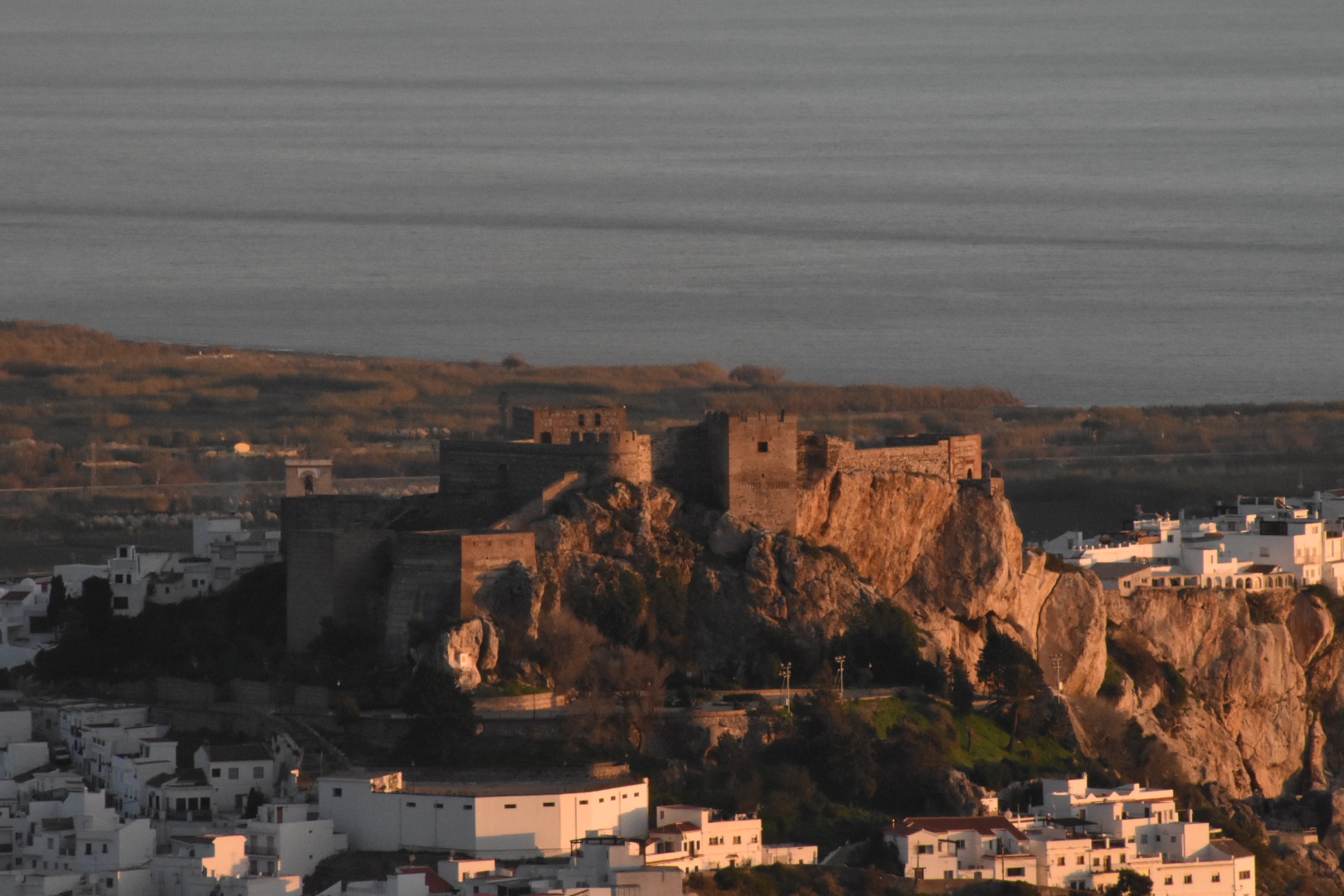
You see Salobreña long before you arrive. Coming along the coast road from Almuñécar or Motril, the town appears as a single white shape — hundreds of houses stacked up a rocky crag that rises abruptly from the flat green coastal plain, the vega, with a castle sitting on top like a crown. It is one of the most dramatic silhouettes on the whole southern coast, and unlike many a postcard view, it survives close inspection. Walk up into it and the drama turns intimate: steep lanes barely wide enough for a delivery van, geraniums in painted pots, washing strung between balconies, the sound of a television drifting from a dark doorway, and every so often a gap between houses that opens suddenly onto the sea.
This is a working Spanish town that happens to be beautiful, not a resort that plays at being one. That distinction shapes everything about living here.
The castle and the view
The Castillo de Salobreña has stood on this rock in one form or another for well over a thousand years, and under the Nasrids of Granada it was a serious stronghold — at times a gilded prison for inconvenient members of the royal family. Today it is restored, open to visitors for a modest fee, and worth every step of the climb. From the battlements you get the full geography of the Costa Tropical in one sweep: the Mediterranean to the south, the green quilt of the vega below, the foothills of the Sierras behind, and on clear winter days snow on the high peaks while you stand in shirtsleeves. Go late in the afternoon, when the light goes honeyed and the swifts start screaming around the towers.
The old town — Barrio de la Villa
The Barrio de la Villa is the old Moorish quarter that winds up to the castle, and it is a proper maze — streets that double back, staircases that dead-end at someone's front door, corners drowning in bougainvillea. The Iglesia del Rosario, a Mudéjar-style church built on the site of the former mosque, anchors the upper town, and a string of miradors along the way give you the view in instalments. It is genuinely steep: locals of a certain age treat the climb as their daily exercise, and anyone considering a house up here should visit in August, carry their shopping up once, and then decide. The reward is silence, sea light and one of the loveliest urban landscapes in Andalucía outside your window.
The beaches and El Peñón
Salobreña's shore is split in two by El Peñón, a great humped rock pushing out into the sea — the town's other landmark and a favourite perch for anglers and sunset-watchers. To its west runs Playa de la Guardia, backed by the open vega and pleasantly undeveloped; to its east, Playa de la Charca, closer to the newer part of town and slightly livelier. Both are long, dark grey sand mixed with pebble, with clear water and a scatter of chiringuitos that come alive in season. These are not golden-postcard beaches, and honesty demands saying so — but they are uncrowded even in July compared with the Costa del Sol, and swimming off the rock in the evening, castle glowing above you, takes some beating.
The vega — sugar cane to chirimoya
The flat green plain around the rock tells the town's economic history. For centuries this was sugar country — the last sugar cane grown anywhere in Europe was cut on this coast — and cane honey, miel de caña, is still made in Motril next door. The cane has given way to subtropical fruit: mangoes, avocados and above all the chirimoya, the custard apple, knobbly and pale green outside, creamy and fragrant within. In autumn the fruit shops and the weekly market pile them high, and you learn to eat them the local way, chilled, with a spoon. The vega also keeps Salobreña visually honest — the town ends and the green begins, with no sprawl of urbanisations between.
Food and the table
Eating here is coastal Granada at its most straightforward: pescaíto frito — fresh fried fish — cold beer, tomatoes that taste of something, and tropical fruit for pudding. The chiringuitos on both beaches do the summer trade in grilled sardines and paella; the bars in town do the year-round trade in tapas that still arrive free with a drink, as is the Granada custom. Drizzle miel de caña over fried aubergines and you have the coast's signature dish. Fine dining is thin on the ground — for that you go to Granada city — but honest cooking is everywhere.
Fiestas and the local year
The patron saint is the Virgen del Rosario, celebrated with the main feria usually in early October, when summer has loosened its grip and the town parties for itself rather than for visitors. The Noche de San Juan, around 23–24 June, fills the beaches with bonfires and midnight swims. Día de la Cruz in early May decorates corners of the old town with flower-covered crosses, and Semana Santa brings sober, atmospheric processions through the steep streets. Dates shift a little year to year, so check locally before planning around them.
Living here
Salobreña is a real town with real services: shops, banks, schools, a weekly market, and a newer health centre in the La Villa district. What it cannot supply — hospital, port, bus station, big supermarkets — Motril supplies ten minutes east. The trade-offs are the mirror image of its charm. It is quieter and far more Spanish than Almuñécar: fewer foreign residents, much less English spoken, and correspondingly fewer international bars, clubs and expat clubs. If you arrive without Spanish you will need to learn some, and most residents who settle here count that a feature. Winters are mild and frost-free thanks to the subtropical microclimate; summers are hot but tempered by the sea. Nightlife is modest, and the town breathes out noticeably between October and June.
Getting around
The A-7 motorway passes just inland, putting Almuñécar minutes to the west and Motril minutes to the east. ALSA buses run along the coast and up to Granada, but there is no train, and both Granada and Málaga airports are roughly an hour away by road. A car is very useful here — near-essential if you plan to live up in the old town or explore the coast properly.
Who it suits
Salobreña suits people who want beauty and everyday Spanish life in the same place: retirees and remote workers happy to trade nightlife for character, families wanting a proper town rather than a resort, and anyone for whom "less English spoken" sounds like an invitation. It will frustrate those who want golden sand, a big expat social circuit, or lively evenings year-round — Almuñécar or the Costa del Sol serve those better. But if the idea of a white town on a rock, a castle at the top of your street and a chirimoya in your shopping basket appeals, few places on this coast do it so well.